Monday, 3 March 2014

Moss and liverwort outing, Fox House, Feb 8th 2014

As reported below by Kate, we had lovely day! Here is a short account of some of the bryological highlights of the day. I am looking for a way to put up on our blog the species list, let me know if you have an idea.

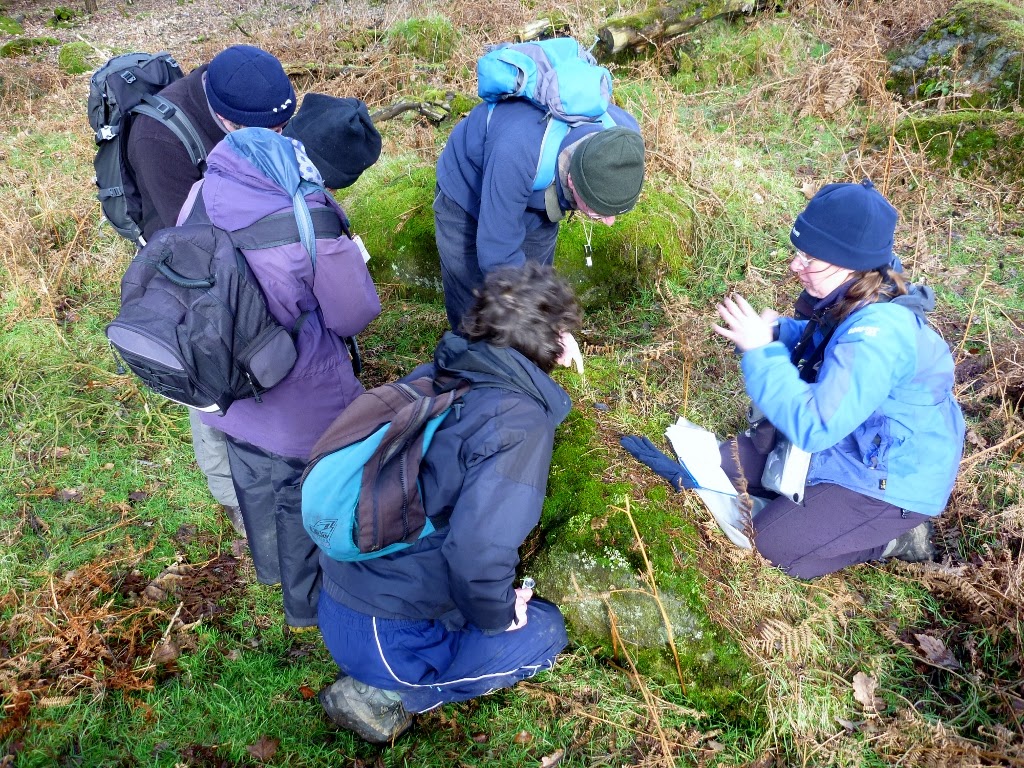
We first explored boulders and trees in a clear woodland part of the Longshaw Estate. Finding Tritomaria exsectiformis was very exciting because this liverwort is uncommon in the area. It was relatively abundant on boulders and bore conspicuous clusters of reddish-brown gemmae (little asexual propagules). 

We recorded many epiphytes including a few unusual species such as Pylaisia polyantha. Tom demonstrated the field characters to look for with this species and Louise managed to photograph the diagnostic capsule lids of conical shape. Many thanks to Louise for sending her picture!

We also spend time looking at commoner species and we got particularly impressed by one patch of Brachythecium rutabulum literally covered with ripe capsules (organs of sexual reproduction). This and other findings led to sobering discussion on the complexity of bryophytes reproduction.

After a detour by a small boggy place with low abundance of Sphagnum, we had lunch sheltered in a conifer plantation where bryophytes appeared less diverse. After lunch we headed off towards the Burbage Brook.
There was a great variety of bryophytes by and in a small tumbling stream we encountered. Species observed include Fontinalis antipyretrica and Dichodontium pellucidum, for instance, and Tom also spotted the rarer Platyhypnidium lusitanicum and Trichostomum tenuirostre.

Three of us continued moss-hunting a bit further down the valley. We dived into a mire dominated by tall rushes and deep water, looking for Sphagnum. We initially struggled to find the common Sphagnum fallax but we were eventually rewarded and all in all found a very good six Sphagnum species plus one specimen pending refereed identification.

This was a very successful outing with 6 field botanist, 16 liverwort species and 67 mosses species recorded ;-)  Thanks a lot to Joan and Tom for sharing their knowledge and experience.

Ambroise

Sunday, 16 February 2014

Bryophytes at Longshaw Estate

On Saturday 8th February, a group of six members from the newly formed South Yorkshire Botany Group braved the bitterly cold winds to explore mosses on the Longshaw Estate at the edge of the Peak District, just a few miles from the outskirts of Sheffield.

The site offered a variety of habitats and mosses were abundant on rocks, trees and on the ground within the woodland. We also explored the area alongside a small stream, and a boggier area of open ground.

As a novice, I was a little overwhelmed by the vast number of species found.  Over 30 species were identified - a full list of species found will be added shortly.

Many thanks to Ambroise for organising the trip.


Brachythecium rutabulum (Rough-stalked Feather-moss)

Orthotrichum pulchellum (Elegant Bristle-moss) 
 
(Photographs by Kate Wright & Louise Hill)
 
Kate Wright

Wednesday, 5 February 2014

Training Day at Old Moor (June 2013)

On Sunday 16th June we met up for a BSBI regional training day led by Mel Linney. This was aimed at beginners like me, though there were more experienced members also attending who were happy to share their experience. 

We met at RSPB Old Moor reserve near Wath on Dearne.

In the morning, we walked the half mile or so to Gypsy Marsh, another piece of land managed by the RSPB but outside the reserve itself. It took us a while to get there, as we kept stopping and looking at things: mainly hedgerow and pond marginals. The session was well organised, focusing on the pea, buttercup and daisy families and with a leaflet provided that showed the key species and features.

At Gypsy Marsh itself there were orchids within a grassland meadow.  As a novice, I tried to get my head around the differences between the two main species and their hybrid versions.

I learned two new buttercup plants I had never even heard of: celery leaved buttercup, a small pond plant with elongated seed heads (pictured); and greater spearwort, another pond plant but this time a giant reaching > 1 metre tall and with elongated leaves.

We had lunch at the RSPB Visitor Centre, then went into the reserve itself. Our first task was to survey orchids in a field closed off from the public. We counted 1000+ orchids, and it was interesting to relate their distribution back to the topography, with the majority occuring in the damper areas in a depression.

We spent the rest of the afternoon meandering down 'Green Lane' which is the main pathway through the reserve. We saw numerous different plants, including more water loving plants in the stream running alongside. It was interesting to see how big some of the Southern Marsh Orchids were growing (around 2 feet tall) due to a combination of plentiful water in the ditch and competition from grasses.

I filled four pages of my notebook with plant species and a brief description, and took numerous photographs.

A great day, and if I can retain half of what I have learned I will be very happy :)

Kate Wright